
MSD technology transfer Epinopegdutide, 7mg group MASH resolution rate of 63%, fibrosis improvement rate of 52%, 4mg was also significant compared to placebo in both indicators... Researchers focus on 7mg in balance of benefits and risks
Hanmi Pharmaceutical (128940) presented evidence that 'Epinopegdutide', a metabolic disorder-related steatohepatitis (MASH) treatment candidate transferred to Merck (MSD) of the United States, can reduce liver fat and improve steatohepatitis and liver fibrosis. Improvement of liver tissue, a key goal of steatohepatitis treatment, was confirmed through biopsy.
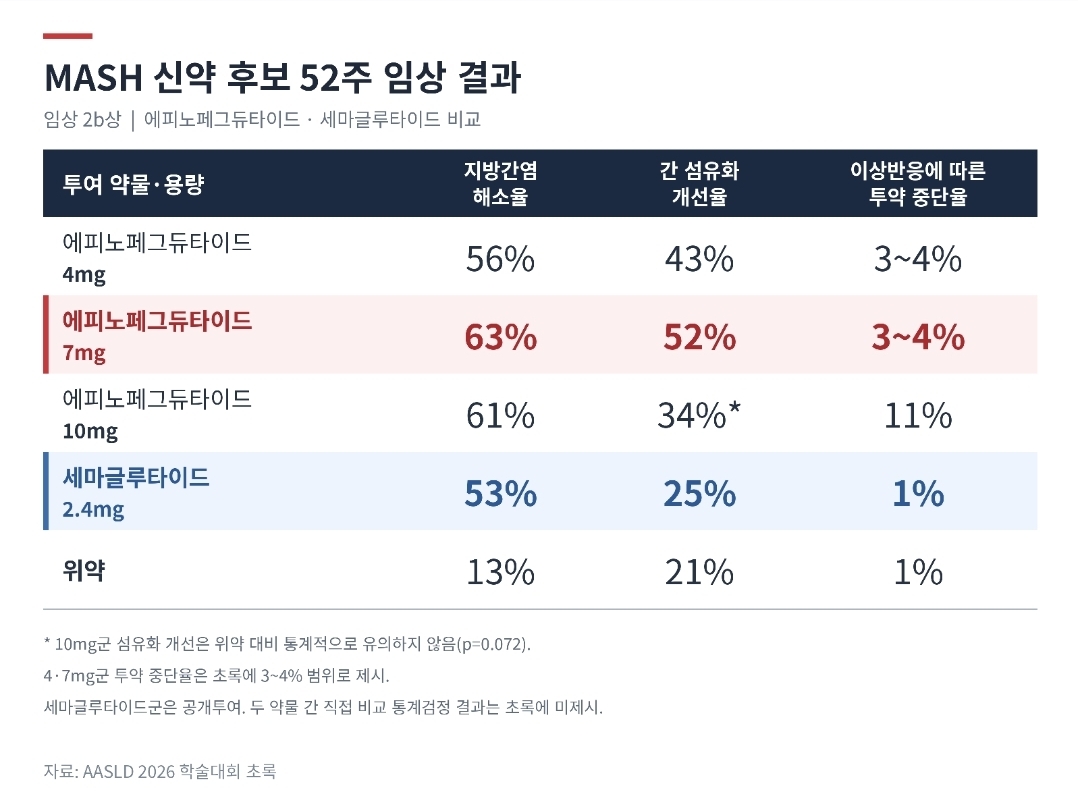
According to the American Society for the Study of the Liver Diseases (AASLD) latest research abstract published on the 6th (Korean time), the proportion of patients in the 7mg group who met the criteria for resolution of steatohepatitis (MASH resolution rate) on biopsy without worsening liver fibrosis after 52 weeks was 63%, nearly five times that of the placebo group (13%). The proportion of patients whose liver fibrosis improved by at least one stage without worsening steatohepatitis was 52%, which was higher than the placebo group (21%). Both indicators showed statistically significant differences (p<0.001 each).
From reducing liver fat to improving inflammation and fibrosis
MASH is a disease in which fat accumulates in the liver, as well as inflammation and liver cell damage. Repeated damage can lead to fibrosis, a build-up of scar tissue. This is why it is necessary to separately check not only whether liver fat has been reduced but also whether inflammation and fibrosis have improved.
Epinopegdutide acts on the receptors of two hormones: GLP-1, which is involved in appetite and blood sugar control, and glucagon, which is involved in fat metabolism in the liver. In the phase 2a clinical trial announced in 2023, the relative reduction rate in liver fat content after 24 weeks of administration was 72.7%, which was higher than the 42.3% in the semaglutide (component of Wigobi and Ozempic) treatment group. The comparative doses at that time were 10 mg of epinopegdutide and 1 mg of semaglutide.
In this phase 2b, improvement in steatohepatitis and liver fibrosis was evaluated through biopsy. 381 adults with MASH and stage 2 to 3 liver fibrosis confirmed by biopsy participated. Fibrosis is classified into stages 0 to 4, with stage 4 corresponding to cirrhosis.
Participants were randomly assigned to five groups, including 4·7·10 mg of epinopegdutide, 2.4 mg of semaglutide, and placebo, and received treatment once a week. The researchers evaluated the effectiveness based on the results of liver biopsy at 52 weeks. The number of patients analyzed for each indicator differed depending on the results of rereading the biopsy before treatment.
It was higher than competing drugs, but it is too early to say it is better.
The MASH resolution rate and fibrosis improvement rate in the semaglutide 2.4 mg group were 53% and 25%, respectively. 2.4mg is the once-weekly maintenance dose recommended for treatment of MASH in the United States. The 7mg epinopegdutide group recorded a numerically higher response rate in both indicators.
However, it is difficult to view this as evidence that it is superior to competing drugs. The semaglutide group was administered in an open administration system in which doctors and patients knew which drug it was. The abstract did not provide the results of a statistical test directly comparing the two drugs.
Effects and adverse reactions differed by dose
The dose that was confirmed to be effective was not only 7mg. The 4mg group also had a MASH resolution rate of 56% and a fibrosis improvement rate of 43%, both of which were statistically significantly higher than the placebo.
The highest dose, the 10 mg group, had a MASH resolution rate of 61%, which was significantly higher than the placebo, but the fibrosis improvement rate was 34%, and the difference from the placebo group (21%) did not reach a statistically significant level (p=0.072).
Adverse reactions also differed depending on the dose. Gastrointestinal adverse reactions were most frequently reported in the 10mg group. The rate of discontinuation of medication due to adverse reactions was 11% in the 10mg group, which was higher than that of the other epinopegdutide dose groups (3-4%) and the placebo and semaglutide groups (1% each).
Summarizing the results, the 7mg group showed the numerically highest response rate in both indicators, and the rate of discontinuation of medication due to adverse reactions was lower than that of the 10mg group. In the abstract, the researchers evaluated that among the doses tested, 7 mg had the most favorable balance of benefits and risks.
Evidence for organizational improvement added to technology transfer assets
On August 4, 2020, MSD and Hanmi Pharmaceutical announced an exclusive agreement regarding the development, manufacturing, and commercialization of Epinopegdutide. The contract at the time included a down payment of $10 million, technology fees of up to $860 million for each stage of development, licensing, and commercialization, and a double-digit royalty rate on sales of licensed products. The condition was that Hanmi Pharmaceutical had the option to commercialize this drug in Korea.
The staged technology fees that Hanmi Pharmaceutical will receive in the future will depend on whether contractual conditions are met during the development, approval, and commercialization process. This phase 2b trial added evidence that this candidate can improve not only liver fat but also steatohepatitis and fibrosis. Dose-specific effects and adverse reaction data can serve as a basis for MSD to select the dose to use in subsequent clinical trials.