Global DRAM Market: Samsung Leads, but SK hynix Gains Ground
Samsung maintains a 38% share, while SK hynix rises to 29%, with DRAM sales increasing over 40%. The race for HBM4 commercialization intensifies as Samsung aims for the top spot next year.
In the global DRAM market, Samsung Electronics (005930) has retained its position as the leader, but SK hynix (000660) is swiftly catching up. While Samsung held steady at a 38% market share, SK hynix saw a remarkable 4% increase in just one quarter. The gap between the two companies has narrowed from 13% to 9% in a single move. SK hynix's revenue growth was driven by rising HBM prices and expanding server memory demand, while Samsung is eyeing a comeback as the leader in the next-generation HBM4 market.
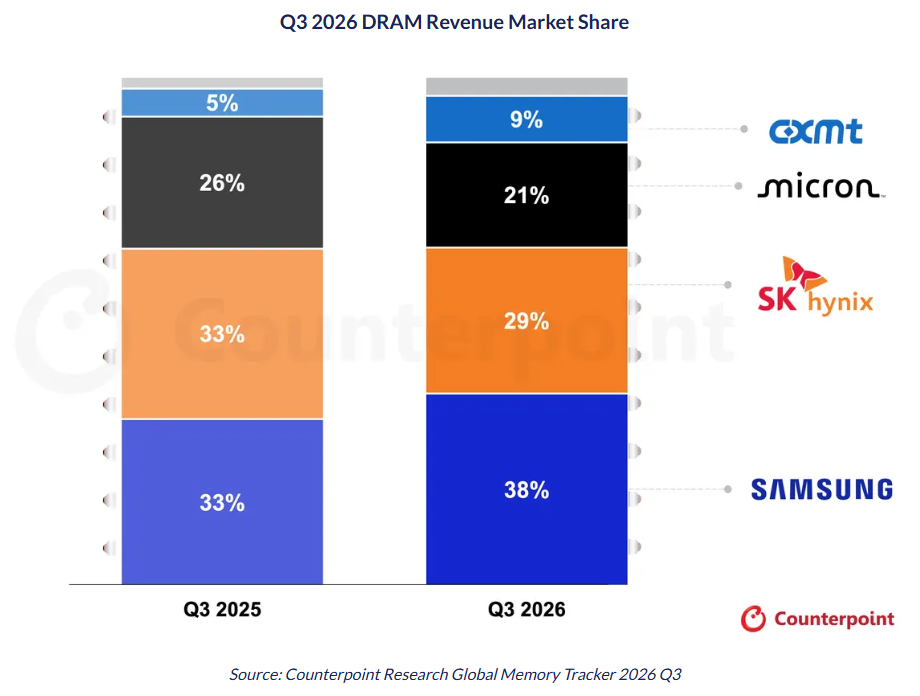
According to market research firm Counterpoint Research, Samsung maintained its top position in the global DRAM market in the third quarter of this year, with a market share of 38% by revenue. SK hynix rose to second place with a 29% share, up from 25% in the previous quarter. Meanwhile, Micron of the United States saw a decline from 24% to 21%, and China's CXMT (Changxin Memory Technologies) dropped from 10% to 9%.
Market Dynamics: A Shift in the Global D-RAM Landscape
When comparing the current year-over-year trends, we observe a notable divergence. Samsung Electronics has seen its market share rise from 33% to 38%, while SK Hynix has experienced a decline, dropping from 33% to 29%. In the third quarter of last year, both companies held equal market shares, but within a year, Samsung has solidified its advantage. However, SK Hynix is making strides to narrow the gap once again during this year's third quarter.
[Source: Counterpoint Research, Global D-RAM Market Share by Revenue, Q3 2025 and Q3 2026]
>
SK Hynix's D-RAM revenue for the third quarter witnessed a substantial increase of over 40% from the previous quarter. This surge can be attributed to the expanded supply of HBM3E and the upward trajectory of memory prices. During the first half of the year, the prices of general-purpose D-RAMs rose more rapidly than HBM, allowing Samsung to reap relatively larger benefits. However, the HBM price has also shown an upward trend since the second half of the year.
The overall market growth has been steep as well. According to Counterpoint Research, D-RAM bit shipments increased by approximately 4% in the third quarter, while revenue surged by an impressive 369% year-over-year. The increase in prices took the lead in driving market growth, rather than sales volume.
The AI-Driven Memory Super Cycle
Counterpoint Research's principal analyst, Choi Jung-koo, stated that the current market is not yet experiencing a sales volume expansion but rather a price-centric "super cycle." He explained that AI's impact on memory has transformed it into a scarce resource, leading purchasers to prioritize securing supply over price negotiations.
The growth of universal DRAM, in addition to HBM, was particularly notable. DDR sales in the third quarter increased by 500% year-over-year, while LPDDR saw a surge of approximately 400%. While HBM sales nearly doubled, its share in the overall DRAM market has decreased.
This shift is attributed to the expanding memory demand of AI servers, which has extended beyond GPU-specific HBM to include DRAM for CPUs. According to Counterpoint Research, the ratio of CPUs to GPUs in AI systems has narrowed from the traditional 4:1 to approximately 2:1, and the trend is moving towards a 1:1 ratio. NVIDIA's next-generation Vera Rubin server features a DRAM capacity of approximately 1.5TB per CPU, nearly three times that of the previous generation.
The Battle for HBM Market Leadership: Samsung's Quest for Regaining the Top Spot
While SK hynix is closing the gap in the overall DRAM market, Samsung is mounting a fierce pursuit in the HBM market.
In the second quarter of this year, SK hynix took the top spot in the HBM market with a market share of 50%. Samsung, on the other hand, saw a significant rise from 21% in the previous quarter to 33%, narrowing the gap between the two companies to 17 percentage points.
Counterpoint Research attributed SK hynix's lead in the HBM3E market to its recent slowdown in growth, while Samsung's HBM4 has received positive feedback from customers. The research firm forecasts that Samsung will take the top position in the HBM market next year.
SK hynix is also accelerating its HBM4 supply expansion. This competition between the two companies is translating into a race for next-generation product supply and customer acquisition.
China's CXMT has been expanding its presence in the generic DRAM market, but there is a significant gap compared to Korean companies in advanced HBM. Reuters reported last month that CXMT is preparing for limited production of HBM3E, but its yield rates are around 20-30%, falling short of SK hynix's approximately 70%.
Memory Supply Shortage Persists, Boosting HBM Prices
The memory supply shortage is expected to continue for the foreseeable future. Counterpoint Research highlights long-term supply contracts as a key factor supporting HBM prices, with major new production facilities not expected to come online until 2028. Market research firm TrendForce also reported on April 4th that server DRAM contract prices are rising, and Samsung Electronics and SK hynix's HBM supply for next year is virtually secured.