SynKIR-310: A Potential Game-Changer in Blood Cancer Treatment
The CAR-T cell therapy, often referred to as a "miracle cancer treatment," has revolutionized blood cancer treatment, but challenges persist with regard to relapse and immune toxicity. HLB Innovation's (024850) U.S. subsidiary, Verismo Therapeutics, is developing the next-generation CAR-T therapy, SynKIR-310, which aims to overcome these limitations.
SynKIR-310 has demonstrated promising results, achieving a complete response rate of 60% in patients with relapsed and refractory blood cancers. Notably, no major immune toxicities were observed, a significant differentiation from existing therapies.
The clinical trial included a high-risk group of elderly patients, a demographic often associated with increased treatment challenges. In contrast to the initial clinical trials of approved CAR-T therapies, where immune toxicity was prevalent among a significant number of patients, SynKIR-310 exhibited an impressive balance between anti-tumor response and the absence of major immune-related adverse events.
In December, the company is set to release the results of an additional clinical trial, which will provide further insights into the therapy's effectiveness at higher dosage levels.
With these early indications of safety and efficacy, SynKIR-310 is poised to differentiate itself from its predecessors, Yescarta and Kymriah, particularly in the areas of commercialization and long-term safety. The market eagerly awaits the upcoming data release, which could potentially reshape the blood cancer treatment landscape.
SynKIR-310 Shows Promising Results in Late-Stage Blood Cancer Treatment
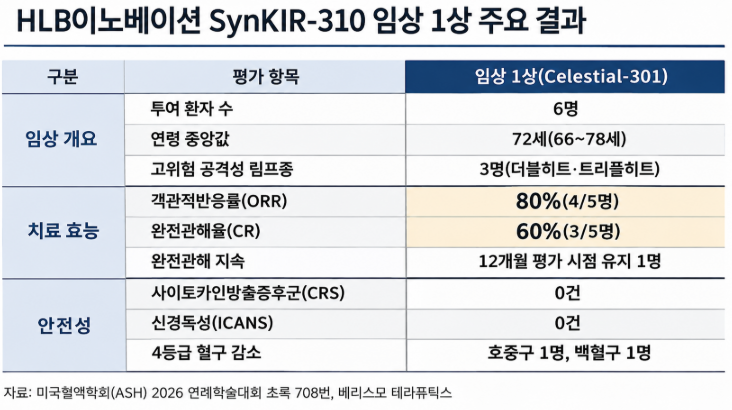
The American Society of Hematology (ASH) revealed promising findings from a phase 1 clinical trial abstract on December 4th, shedding light on the potential of SynKIR-310. The study focused on patients with relapsed or refractory B-cell non-Hodgkin lymphoma, administering SynKIR-310 to six individuals. These patients had undergone at least two prior treatment regimens, with a median age of 72 years. All participants were diagnosed with advanced-stage (3-4) lymphoma, including three patients with aggressive lymphoma, who presented with challenging double-hit or triple-hit genetic abnormalities.
Remarkably, four out of five evaluable patients exhibited a therapeutic response, with three achieving complete remission (CR), a state where no signs of cancer were detected. One of these complete remission patients maintained their response at the 12-month mark.
The safety profile of SynKIR-310 is also noteworthy. None of the six treated patients experienced the common CAR-T therapy side effects, Cytokine Release Syndrome (CRS) or Immune Effector Cell-Associated Neurotoxicity Syndrome (ICANS). No dose-limiting toxicities or treatment-related serious adverse events were reported. Grade 4 neutropenia and leukopenia were observed in one patient each.
These early-stage findings provide a glimmer of hope for late-stage blood cancer patients, particularly those with high-risk profiles. Further research and larger-scale trials will be crucial to validate these initial results and determine the long-term efficacy and safety of SynKIR-310.
SynKIR-310: A Promising CAR-T Therapy with Reduced Immune Toxicity
The CAR-T therapy field has been marked by significant advancements in cancer treatment, yet the burden of immune toxicity has been a critical concern. Gilead Sciences' Yescarta, following the ZUMA-1 Phase 1 trial, saw CRS occur in 6 out of 7 patients, with 3 or higher grade neurotoxicity in 4 patients. Similarly, Novartis' Kymriah, during the CTL019 early-stage study, reported severe CRS in 5 out of 28 patients and neurological adverse events in 11. While direct comparisons are limited due to varying patient demographics and evaluation criteria across trials, SynKIR-310 has demonstrated a potential safety advantage, as key immune toxicities observed in early studies of approved CAR-T therapies were not present.
>
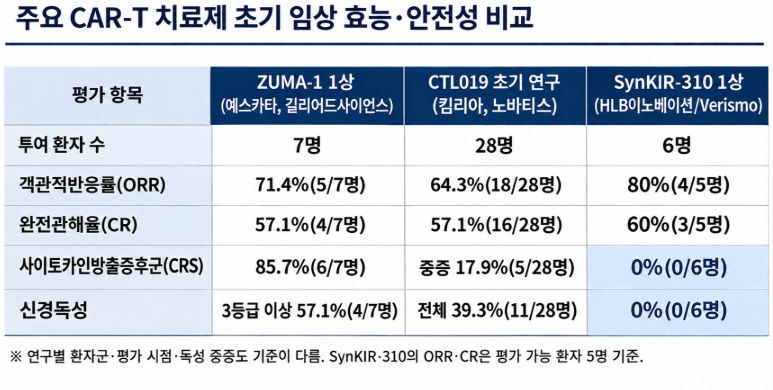
Hyunsuk Kim, an analyst at Hyundai Motor Securities, highlighted the positive outcome of administering SynKIR-310 to older patients without observing any grade 1 or higher CRS or neurotoxicity (ICANS). He further emphasized the significance of these results, stating that "complete remission was achieved without any major immune toxicities, which sets this early-stage CAR-T therapy apart from existing treatments."
KIR-CAR: A Potential Game-Changer for Cancer Immunotherapy
The selection of ASH oral presentation is seen as a recognition of its safety profile, which has been a key focus. In terms of efficacy, early indications suggest potential, and further evaluation can be made through the Cohort 3 results and lymphoma subtype-specific treatment responses, differentiating it from existing approved therapies.
If the anti-cancer effects and low immune toxicity are replicated in future clinical trials, KIR-CAR could offer a novel solution to the safety concerns that have been a significant burden for CAR-T therapies.
Reducing Immune Response: KIR-CAR's High-Capacity Trial
Verismo's KIR-CAR differs from traditional CAR-T in its receptor design. By separating the recognition of cancer cells and the activation signal for T-cells, and utilizing the signal transduction protein DAP12 from natural killer (NK) cells, KIR-CAR aims to maintain anti-tumor activity while reducing excessive immune responses.
With a focus on this multi-chain receptor design, Verismo is targeting a high-capacity trial of 1 billion cells, aiming to revolutionize cancer treatment.
SynKIR-310: A Promising CAR-T Therapy with Distinct Advantages
The preclinical studies previously unveiled by Verismo have highlighted the technical superiority of KIR-CAR. In the animal experiments presented at last year's ASH conference, SynKIR-310 demonstrated a rapid and potent tumor suppression effect at lower doses compared to traditional single-chain CAR-T therapies. On day 13 of the experiment, the cytokine levels in the control group treated with single-chain CAR-T were significantly higher, with IFN-γ at 37 times, TNF-α at 27 times, and IL-2 at 17 times the levels observed in the KIR-CAR treatment group. Verismo plans to further showcase the direct comparison between these two technologies at this year's ASH conference, providing additional preclinical insights.
Clinical Trial Dosage and Potential Impact
The T-cells administered in this clinical trial were dosed at 100 million for the first cohort and 300 million for the second. For reference, the FDA-approved Yescarta has a maximum dosage of 200 million cells, while Kymriah's dosage range for adult lymphoma treatment is between 60 million and 600 million cells. It is important to note that there are variations in the calculation methods and characteristics of these products. SynKIR-310 has shown no significant major immune toxicity within the dosage range that overlaps with existing approved therapies.
The Next Challenge: Testing the Third Dose Level
The upcoming trial phase will focus on the third dose level, administering 1 billion cells, which is approximately 3.3 times more than the previous dose of 300 million cells. This test will determine the anti-tumor efficacy and assess any potential immune toxicities.
Researcher Kim highlighted that traditional CAR-T therapies often exhibit limited efficacy improvements with increased dosage, while also increasing toxicity concerns. They stated, "SynKIR-310 has shown no significant immune toxicities to date, so the key will be to determine if it can deliver deeper therapeutic effects at higher doses."
Furthermore, Kim added that certain subtypes, such as follicular and marginal zone lymphomas, have already demonstrated high response rates with existing approved CAR-T treatments. Therefore, it is essential to evaluate individual patient responses and analyze the additional data from Cohort 3.
Verismo Therapeutics is scheduled to present further clinical results, pharmacokinetics, and pharmacodynamics (PK/PD) analysis data from Cohort 3 at the ASH Regular Oral Presentation on December 13th. The focus will be on the safety, anti-tumor response, and proliferation and persistence of therapeutic cells in patients receiving the higher 1 billion cell dose.