Hanwha's Naval Breakthrough: Securing a Landmark Deal
In a significant move, Hanwha has acquired the first-ever contract to build a U.S. Navy landing ship, solidifying its position as a key player in the American shipbuilding industry. With the U.S. facing delays in its naval construction and a shortage of shipyards, Hanwha seized the opportunity by acquiring local shipyards and securing this lucrative contract.
The deal, valued at $269 million (approximately $357.5 million), marks a pivotal moment for Hanwha's expansion into the U.S. naval market. The company will initially construct one medium-sized landing ship (LSM) for the U.S. Navy and Marine Corps, with an option to build an additional three vessels, potentially bringing the total to four. Construction is set to commence in the fourth quarter of 2027.
These medium-sized landing ships, measuring approximately 100 meters in length, play a crucial role in transporting Marine Corps personnel and equipment to islands and coastal areas. The U.S. plans to acquire a total of 35 such ships to support the Marine Corps' dispersed operations in the Indo-Pacific region.
Hanwha's strategic acquisition of local shipyards and its utilization of South Korean shipbuilding expertise have enabled it to establish a strong foothold in the U.S. naval market. This move not only strengthens Hanwha's position but also addresses the U.S. Navy's critical need for timely and efficient shipbuilding.
Hanwha's Defense Arm Secures US Navy Contract Amid Changing Procurement Practices
Hanwha's US Subsidiary Wins Medium-Sized Landing Ship Contract
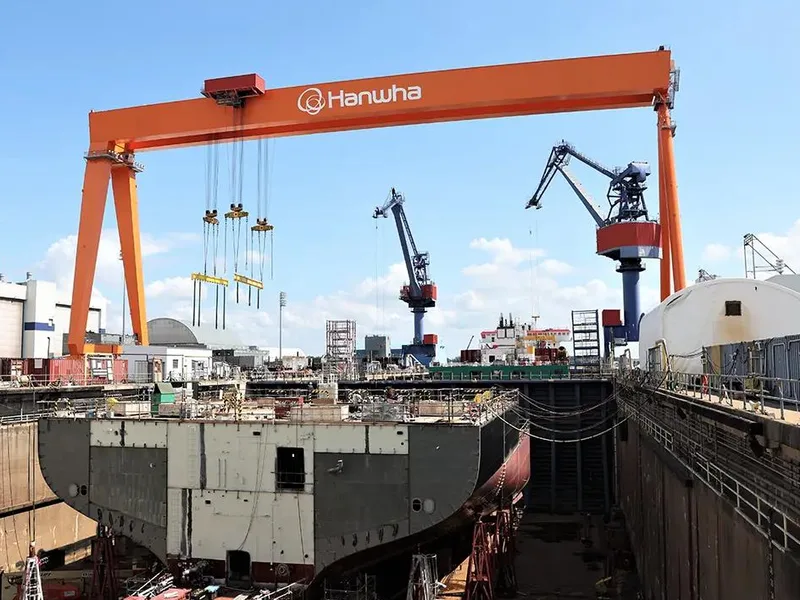
The actual construction will be undertaken by Philis Shipyard, which was jointly acquired by Hanwha Ocean and Hanwha System at the end of 2024. Hanwha Ocean is transferring the production technology of its Geoje Shipyard to the local facility, and this contract was secured by Hanwha Aerospace's US defense subsidiary, Hanwha Defense USA.
#### US Navy's New Procurement Approach: Hanwha Wins Competitive Bid
The US Navy introduced the Vessel Construction Management (VCM) method for this medium-sized landing ship project. By delegating contract and construction management to a specialized firm instead of directly managing each shipyard, the Navy aims to reduce delays and cost overruns.
The US vessel construction management firm, TOTE Services, conducted a competitive bidding process among local shipyards in July. Hanwha Defense USA was selected as the construction firm, recognized for its price competitiveness and contract terms.
Jeff Dixon, President of TOTE Services, stated at the contract announcement, "This contract demonstrates how swiftly the VCM method can progress from bid request to contract closure."
Hanwha's Shipbuilding Expansion and Navy Contracts
Hanwha has secured a significant foothold in the U.S. Navy's shipbuilding industry, with a $2.2 billion contract for project management. The company has confirmed the acquisition of one vessel, with the potential for up to eight ships to be managed under this deal.
Other notable players in this sector include Bollinger Shipyards and Marinette Marine, a subsidiary of Italy's Fincantieri. Bollinger has secured the lead ship construction contract, while Marinette Marine is involved in long-term material supply agreements. TOTE Services, the project manager, is currently in discussions with both companies for additional build contracts.
With a rich history, Philippi Shipyards brings valuable experience to the table. They have successfully delivered four out of five National Security Multi-Purpose Vessels (NSMV) for the U.S. Maritime Administration, managed by TOTE Services. The final vessel is scheduled for delivery in 2027. This acquisition allows Hanwha to leverage established manpower and supply chains for its new military shipbuilding ventures.
A $50 Billion Investment Plan for a $100 Million Shipyard
Hanwha's acquisition of Philippi Shipyards for approximately $100 million in December 2024 has led to a significant expansion plan. Last August, the company announced a long-term investment strategy worth $50 billion, which includes the construction of two new docks, three new wharves, and the expansion of ship block assembly facilities.
Hanwha's Ambitious Shipbuilding Venture in the U.S.
Since acquiring the Philadelphia shipyard, Hanwha has invested approximately $350 million in welding and painting equipment, educational facilities, and production upgrades. The approved investment for the next phase, until the end of 2027, amounts to a further $400 million.
In September, the company secured an additional 47-acre lease (approximately 190,000 square meters) adjacent to the shipyard. Combined with the existing 110 acres, the total site area will expand to roughly 157 acres, a growth of over 40% from the original size.
So, what scale of shipyard is Hanwha aiming to build with this $5 billion investment?
Hanwha's long-term production target is an ambitious 20 vessels per year. Currently, the Philadelphia shipyard builds ships at an average rate of one vessel every eight months. By expanding the docks and assembly facilities, Hanwha plans to increase production capacity to build multiple ships simultaneously. This target includes both warships and commercial vessels.
Along with facility expansion, Hanwha is introducing production technologies from its Korean shipyards. The company is implementing an Enterprise Resource Planning (ERP) system and production management tools similar to those used at its Geoje shipyard. Additionally, they are expanding welding automation equipment and focusing on streamlining the shipbuilding process by managing schedules for each stage, from material supply to final assembly, to reduce construction timelines.
Accelerated Production Capacity Expansion: A Strategic Move
The urgency behind the expansion of production capacity is driven by the already secured orders for merchant vessels. Phili Shipyard has secured contracts for four medium-sized oil tankers and chemical product carriers, with an option to build an additional six vessels. Furthermore, they are scheduled to construct two LNG carriers. The first delivery of the oil and chemical product carriers is targeted for early 2029.
This timeline is further intensified by the commencement of the U.S. Navy's medium-landing ship construction, starting in the fourth quarter of 2027. With the current production capacity, it is challenging to keep up with the increasing demand, hence the need for additional docks and skilled workforce. The employment at Phili Shipyard has increased from approximately 1,800 before Hanwha's acquisition to a recent count of 2,300, with plans to expand further to over 4,000 in the long term.
Hanwha has secured an initial order for one medium-landing ship, with the option to build three additional vessels, bringing the total potential build to four. Given the U.S. Navy's plan to introduce 35 such ships, there is a potential for further orders. The speed at which Hanwha can enhance Phili Shipyard's production capacity will determine its market share and business opportunities in the U.S. naval shipbuilding market.