Life science growth strategy presented in IPO report... Acquisition of bio companies and expansion of research base
Big Hat and antibody optimization results revealed... Treatment effectiveness and commercialization potential require further verification
Antropic, an artificial intelligence (AI) company, is entering the life sciences field in earnest. Not only does it supply AI for research to pharmaceutical and bio companies, but it also has its own research organization and laboratory and is directly participating in the new drug development process. The plan is to deploy Claude from candidate material design and experiment data analysis to clinical trial plan development.
Antropic presented life sciences as a new market to enter in its initial public offering (IPO) securities report submitted to the U.S. Securities and Exchange Commission (SEC) on October 26 (local time). The company explained that it is building an AI agent that supports scientists at each stage of new drug discovery and development.
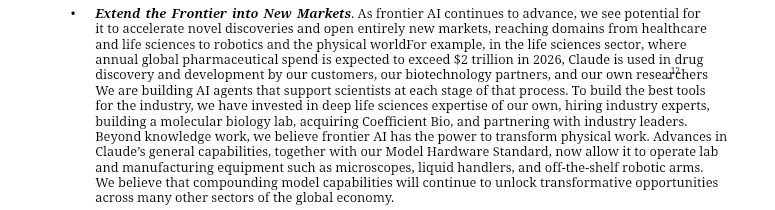
[Photo caption=Life science business strategy section of the securities report submitted by Antropic to the SEC. Data = Antropic S-1, SEC EDGAR.]
제약사 고객 확보…인수·자체 도구로 연구 역량 보강
According to the disclosure, customers who each generated sales of more than $100,000 to Antropic in the previous 12 months as of September 30 included 9 of the top 10 pharmaceutical companies and 8 of the top 10 healthcare companies in the Fortune 500. This figure is based on the total amount of Antropic products and services used, and does not mean that all of the expenditure was used for new drug research.
We are also making investments to increase research capabilities. Antropic acquired Coefficient Bio, an AI company for biological research, in April this year. They announced that they are also pursuing the establishment of a molecular biology laboratory, recruitment of professional personnel, and industry cooperation.
They also released products for researchers. ‘Claude Science’, which was released last June, is an app that supports literature search, data analysis, and execution of research programs in one environment. It is designed to allow researchers to verify and reproduce the results by leaving the code used in the analysis and work history together.
항체 최적화부터 임상 계획까지…실험·문서 작업에 적용
There were also cases of application in actual new drug research. On October 27, Antropic disclosed the details of its collaboration with six organizations, including Big Hat Biosciences, Bristol Myers Squibb (BMS), and Enveda. Depending on the research subject and development stage, Claude was used for different tasks such as molecular design, candidate material optimization, clinical plan establishment, and manufacturing and regulatory document work.
According to Antropic's announcement, the research with Big Hat produced and tested about 1,010 variants using two types of antibody fragments over a period of 10 weeks. When Claude and Antropic researchers proposed structural changes, Big Hat researchers verified them in the automation laboratory and reflected the results in the next design. Big Hat said that this process was supported by a data environment that linked measurement values from experimental equipment, sample information, and quality control records in one place.
The researchers obtained variants with increased target binding ability, and also improved the stability and aggregation characteristics of each antibody. Antropic explained that the antibody fragment targeting cancer cells remained in solution even at a temperature of 18 degrees Celsius higher than before, and the aggregation speed of other antibody fragments to increase the drug's residence time in the body was slowed by more than 100 times.
This case shows the process of verifying and revising the design proposed by AI with experimental data. This means that a system that returns experiment results quickly is as important as AI’s analysis capabilities.
Claude's role also extends to the stage after candidate material design. BMS uses Claude to review development plans for early clinical stage drugs and assess the likelihood of trial success. Enveda applied the task to review manufacturing documents and draft regulatory submissions. The goal is to support not only research but also analysis and documentation work that occurs during the development process.
연구 성과와 치료제 상용화는 구분해야
However, it is too early to interpret the published results as effective in treating patients. Antropic said that most of the research introduced this time is in the preclinical stage before testing on humans. Improvements in antibody binding and stability are also characteristics measured in the laboratory, and are not results that prove clinical effectiveness or safety.
The company also stated in its securities filing that candidate substances derived from life science research must go through a long-term development and regulatory process and may not ultimately generate sales.
This move is interpreted as a strategy to connect Antropic's experience in new drug development to product improvement and customer expansion. In order to judge future business feasibility, in addition to the performance of individual experiments, it is necessary to look at how much the development period and cost can be reduced, and whether the usefulness is proven in follow-up clinical trials.