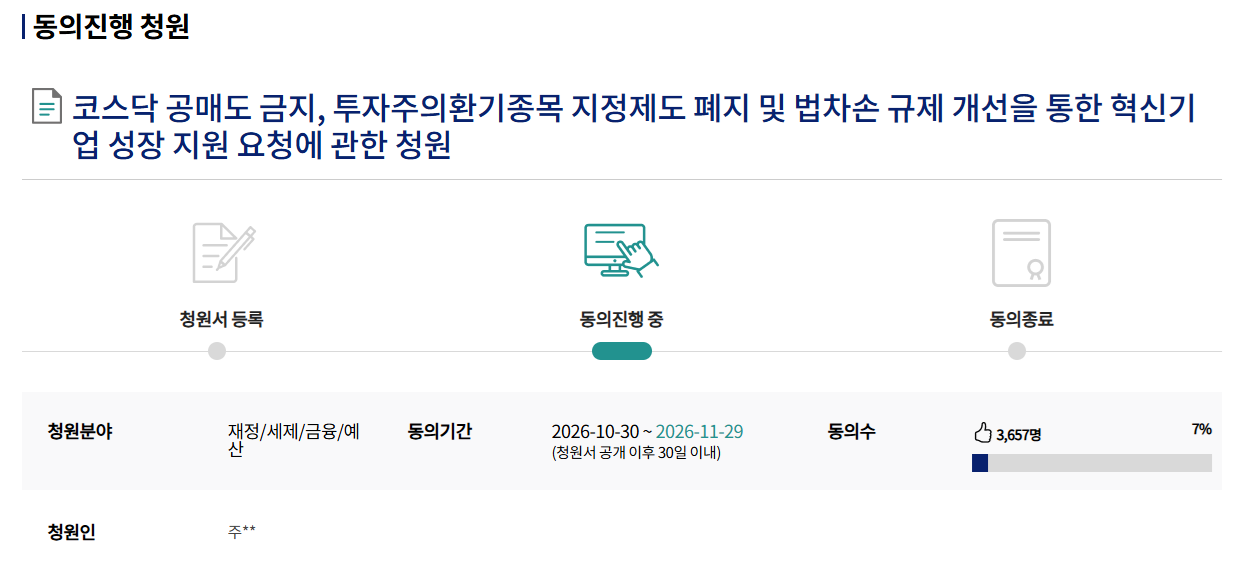
Call for ban on short selling, abolition of investor caution issues, and improvement of legal loss regulations.
There is a need to distinguish between R&D losses and poor management… Challenges to support growth and protect investors
With KOSDAQ on the verge of collapsing below the 700 mark, petitions calling for a ban on short selling and improvement of the listing maintenance system are continuing. It is argued that the characteristics of KOSDAQ, which provides growth funds to innovative companies, should be reflected in the current regulations.
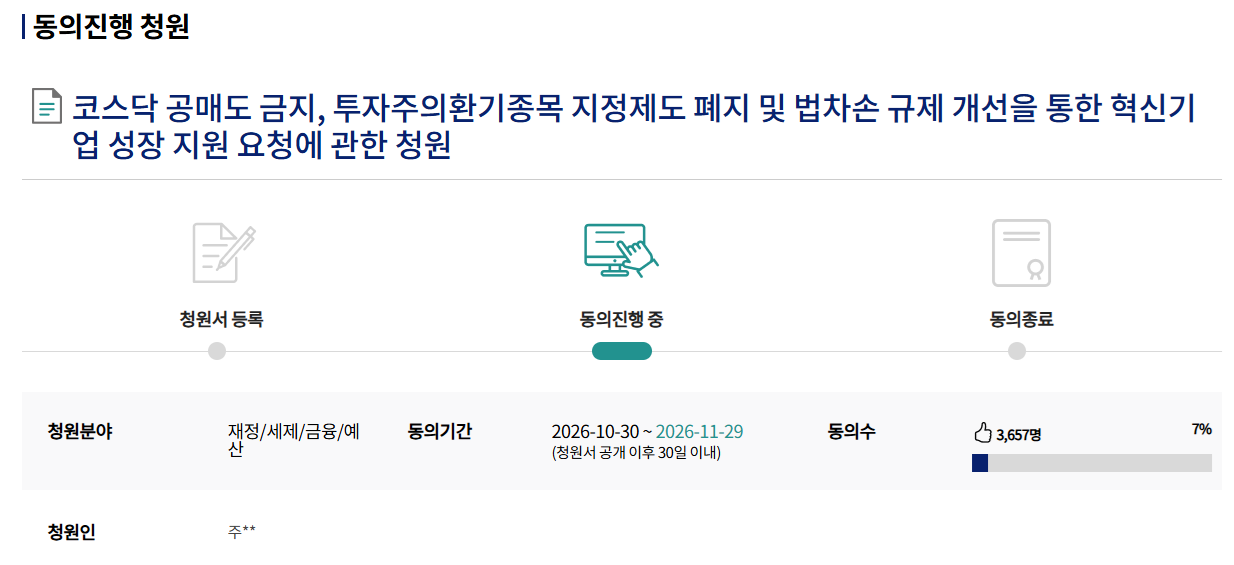
Following the release of a petition for public consent last July requesting a six-month temporary suspension of short selling on the KOSDAQ and an investigation into the actual situation, petitions have recently appeared calling for a principled ban on short selling, abolition of the investment caution designation system, and improvement of regulations on loss from continuing operations before corporate tax expenses (statutory loss). Distrust of short selling has expanded into raising questions about KOSDAQ's growth finance function and the overall listing maintenance system.
KOSDAQ pushed back to the 720s… Distrust toward the short selling system
The weakness of KOSDAQ is increasing investor anxiety. On October 30, the KOSDAQ index closed at 724.38, down 28.85 points (3.83%) from the previous trading day. The index, which once exceeded the 1,200 mark last April, is now under threat of even the 700 mark.
Investors calling for a ban on short selling argue that if short selling is concentrated in a specific stock, downward pressure on stock prices will increase regardless of corporate value, and individual investors' losses may also increase. It is pointed out that the gap in financial and information power between institutions and individuals can make it difficult to form fair prices.
This petition emphasizes that KOSDAQ is a market for raising growth funds for innovative companies such as bio, artificial intelligence, and semiconductors. As the company composition and market characteristics are different from KOSPI, short selling regulations must take into account the characteristics of KOSDAQ.
However, a separate analysis is needed to determine whether short selling is the main cause of the recent decline in KOSDAQ. Short selling also has the function of price discovery and suppressing overheating. To determine whether or not to ban, short selling transactions and balances, market liquidity, and trading by other investment entities must be comprehensively examined.
Operating loss for 5 consecutive years… Controversy over criteria for designating ventilation items
The standards for designating investment caution items are also controversial. KOSDAQ stipulates that an operating loss occurred in each of the last five fiscal years as one of the reasons for designation. However, there is an exception where this standard does not apply to technology growth companies.
The petition raises the question of whether it is appropriate to apply the continuous operating loss standard to companies that require long-term research and development. It is necessary to distinguish between deficits arising from investments for future growth, such as new drug development, and deficits resulting from loss of business competitiveness.
In fact, research and development-oriented companies often incur costs before sales before product commercialization. In this process, there are concerns that if it is designated as a volatile stock, investment sentiment will decline and the burden of financing will increase, which may affect research and development.
On the other hand, the ventilation stock designation system also serves the function of providing risk signals to investors. The reasons for designation include not only continuous operating losses but also weaknesses in the internal accounting management system. In order to abolish or relax the system, it is necessary to distinguish between R&D losses and management transparency issues and prepare alternative methods to provide risk information.
Legal loss regulation… Distinguish between R&D losses and financial risks
The criteria for designating management items based on legal margins are also an issue. According to the current regulations, in principle, if a legal loss exceeding 50% of equity capital occurs in two of the last three fiscal years, the loss is more than KRW 1 billion, and there is a legal loss in the most recent fiscal year, the company may be designated as a management item. The application is postponed for a certain period of time for companies with technological growth.
The bio industry has been concerned that the burden on technology development and financing may increase if legal loss regulations are applied in a situation where long-term research and development expenditures are reflected as losses.
This petition also pointed out accounting factors such as non-cash valuation losses related to convertible bonds. It is argued that even if some financial liability valuation losses are excluded from the calculation of legal loss, the legal loss ratio may increase due to a decrease in equity capital.
The key is to look at not only the size of the loss, but also the cause of the loss and the progress of the business. There is a need to review whether it is appropriate to equally evaluate the deficit incurred during the R&D investment process and the loss accumulated due to weakening business competitiveness.
However, financial risks cannot be ignored just because it is an innovative company. Cash flow, financing capacity, research and development progress, and commercialization potential must be comprehensively evaluated, and information must be provided so that investors can sufficiently determine the risk of capital damage.
Individual-centered market… Opinions need to be reflected in policy discussions
The high level of participation of individual investors is an important variable in discussions about the KOSDAQ system. According to statistics from the Korea Exchange, as of October 30 this year, individuals accounted for 65.4% of the total trading volume on KOSDAQ. Although it is lower than 79.3% in 2024 and 73.8% last year, it is still the highest proportion.
Although the proportion of transactions by foreigners and institutions is increasing, individual investors are still the center of KOSDAQ trading. Another challenge is how to collect and reflect their opinions in the process of system improvement.
Of course, accepting all the demands contained in the petition is not the solution. The effects and side effects of the short selling ban must be verified, and investor protection measures that filter out insolvent companies must also be maintained. Support for innovative companies should not lead to protecting insolvent companies.
However, this petition should not be viewed as a simple request to stimulate the market. It is also a request to improve the system so that investors can properly assess risks while ensuring time for innovative companies to grow.
Policy authorities and exchanges need to respond to these issues by reviewing specific systems and providing alternatives. The principle of filtering out insolvent companies must be maintained, but it must be checked whether the current standards and exception regulations sufficiently reflect the characteristics of companies where investments for the future result in immediate losses.