Global Memory Semiconductor Market: Supply Shortage Persists, but at a Reduced Rate
The global memory semiconductor market is expected to remain in a supply shortage state through 2027. While the scale of the shortage is anticipated to decrease due to increased production, the demand driven by artificial intelligence (AI) servers and data centers is projected to support the overall market. However, there may be variations in the supply and demand dynamics for DRAM and NAND flash, influenced by the slowdown in consumer memory demand and the expansion of production capacity.
Citi Reduces Supply Shortage Forecasts for DRAM and NAND
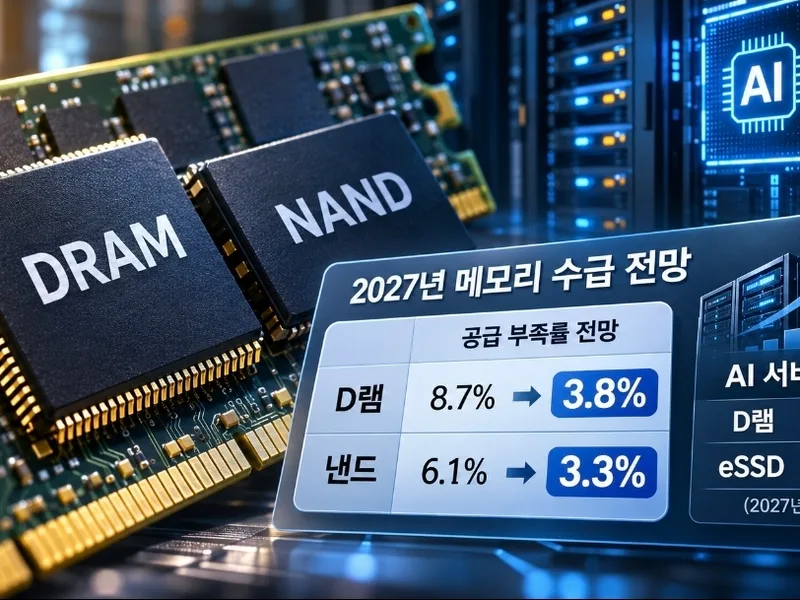
Citi, in its outlook released on March 3rd, revised its forecast for the global DRAM supply shortage rate from 8.7% to 3.8% for 2027. The projected supply shortage rate for NAND flash was also lowered from 6.1% to 3.3%. These adjustments reflect the incorporation of major memory manufacturers' plans to increase production, leading to an upward revision of the supply forecast.
Supply and Demand Outlook for DRAM and NAND
Citi anticipates a significant increase in DRAM supply, projecting a 24% year-over-year growth, while demand is expected to surge by 28% in 2027. For NAND, supply and demand growth rates are estimated at 22% and 26%, respectively. Notably, the forecast for NAND demand growth has been revised downward from 29% to 26%, reflecting the sluggish demand for consumer products. DRAM demand forecasts have also been slightly adjusted to account for the slowdown in smartphone usage.
Strong Growth in AI Server Memory Demand
On the positive side, Citi foresees a robust growth in memory demand for AI servers. The financial institution predicts that server-grade DRAM and enterprise solid-state drives (eSSD) will experience a substantial surge in demand, with year-over-year increases of 53% and 52%, respectively, in 2027.
Production Capacity Expansion and Supply Constraints
Despite efforts to expand production facilities, supply constraints remain a concern. The construction, certification, and expansion of new DRAM production facilities typically take 2-3 years or more, according to an analysis by the Center for Strategic and International Studies (CSIS) released in September. Consequently, even with expanded production capacity in 2027, the full impact on supply may be delayed. CSIS also highlights that the contribution of new production facilities to supply could be more significant post-2028.
The Impact of HBM Production on the DRAM Market
The expansion of high-bandwidth memory (HBM) production is a critical factor influencing the supply and demand dynamics of general-purpose DRAM. HBM and DRAM share some manufacturing processes and resources, so an increased focus on HBM production could limit the available capacity for other DRAM products.
Citi and TrendForce's Divergent Views on NAND Supply
Market research firm TrendForce, in a report released last July, anticipated supply constraints for DRAM due to the allocation of production capacity towards HBM and the rising demand for AI servers. Conversely, they predicted that NAND would experience improved supply conditions from the second half of 2027 onwards, driven by the activation of new production capacity and sluggish demand for smartphones, PCs, and other electronic devices.
While TrendForce forecasts an annual supply surplus for NAND in 2027, Citi expects the supply shortage to persist. However, it is important to note that the timing of these forecasts, July and November respectively, makes it challenging to interpret this as a direct disagreement between the two institutions.
The Future of Global Memory Markets: AI-Driven Demand and Supply Dynamics
### AI-Agent Spread and SSD Demand
TrendForce suggests that the rapid increase in SSD demand due to the spread of AI agents could bring the NAND supply and demand back into balance sooner than expected. The key to the NAND market's performance lies in how much data center investments can offset the sluggish demand for personal devices.
### Memory Pricing and Supply Dynamics
The future pricing of memory is influenced not only by the persistence of supply shortages but also by how quickly the supply-demand gap narrows. The expansion of long-term supply agreements (LTA) is also a factor that can alter the price trajectory. Citi analyzes that memory manufacturers are prioritizing securing mid- to long-term visibility through long-term contracts rather than short-term price increases. Even with ongoing supply shortages, the actual selling price movements can vary depending on the trading terms and contract structures.
### Global Memory Market Outlook for 2027
Ultimately, the global memory market's fate in 2027 hinges on the speed of AI-related demand growth and the timing of new production capacity reaching actual supply levels. With the continued growth of server DRAM and enterprise SSDs, the recovery of consumer memory demand will determine the product-specific supply-demand imbalances and price trends.