
Director Yeon Sang-ho's new film recovers net production costs before domestic release through overseas sales, combining production scale and distribution strategy... Focus on profit structure beyond the number of viewers
When talking about the success of a movie, the first number that comes up is the number of audiences. How many people are brought to the theater is used as a performance report card. Director Yeon Sang-ho's new film 'Paradise Lost' also attracts attention with other numbers. The net production cost is approximately 500 million won, and overseas sales are to 118 countries. Net production costs were recovered through overseas sales prior to domestic theater box office success.
Distributor CJ ENM announced on the 19th of last month that the overseas sales revenue of 'Paradise Lost' exceeded the net production costs. This was achieved even before it was released in Korea on the 21st of the same month. Director Yeon's low-budget project, which followed last year's 'Face', which was completed with a net production cost of about 200 million won, met with overseas distribution networks and secured a recovery route that did not rely solely on mobilizing domestic audiences.
A son recreated by AI and a real son... How far does love accept change?
'Paradise Lost' is a psychological thriller that begins with the return of Ryu Seon-woo, the son thought dead, to Ryu So-young, a mother who lost her son in a disappearance nine years ago. Kim Hyun-joo plays So-young and Bae Hyun-seong plays Sun-woo.
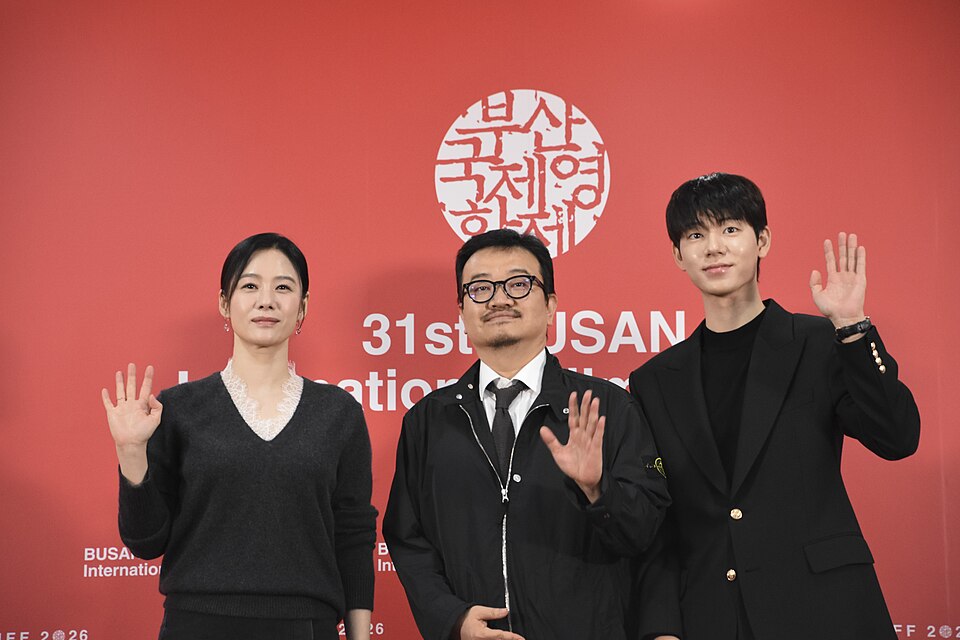
[Photo caption=Actress Kim Hyun-joo (from left), who appeared in director Yeon Sang-ho's film 'Paradise Lost', director Yeon Sang-ho, and actor Bae Hyun-seong are taking a commemorative photo at the 31st Busan International Film Festival. /Photo = Arielaortizb/Wikimedia Commons (CC BY-SA 4.0)]
After her son disappeared, Soyoung endured the absence by talking to her son, who was recreated by artificial intelligence. However, when the actual son returns as a grown man, conflict begins. A gap has appeared between the AI that retains the image in its memories and the real-life son from whom he has been separated for a long time.
This setting makes us look at the problems that arise when technology enters human relationships rather than the performance of AI. When a loved one returns in a different form than we remember, how much can we accept the change? Isn't the existence created to soothe loss actually blocking real relationships?
This is the point where the contemporary material of AI overlaps the familiar emotions of family loss and reunion. The distributor also explained that the story that expressed the universal emotions of family and motherhood attracted the attention of overseas markets. Although this is the distributor's evaluation, it is a clue to see how the work connects technical materials and human emotions.
The film was first released at the 51st Toronto International Film Festival and was also shown at the 31st Busan International Film Festival. Following the 46th Hawaii International Film Festival, it was also invited to the 37th Stockholm International Film Festival. According to CJ ENM, the European premiere will be screened in Stockholm on November 12th and 22nd local time. Along with selling overseas copyrights, we are also expanding our contact with audiences through film festivals.
Low-budget success should not be read solely as a formula for cost reduction.
What is noteworthy in this case is not only the size of the production cost. The question is how to determine the production scale appropriate for the work and connect it to the market in which it will be sold. An overseas sales contract was signed for 'Paradise Lost' even before it was released at the Toronto International Film Festival in September, and additional sales continued even after the screening. Rather than pushing for overseas expansion after checking the domestic release results, the film secured demand in various markets before and after the work was released.
In this process, it is necessary to look at the awareness of director Yeon, who made his name known overseas through 'Train to Busan', and the sales capabilities of the distributor. CJ ENM explained that it is the result of a combination of overseas market trust in Director Yeon's world of work, original story, and the company's global business capabilities.

[Photo caption=Director Yeon Sang-ho is attending the 31st Busan International Film Festival. Photo = Arielaortizb/Wikimedia Commons (CC BY-SA 4.0)]
Even if the number of audiences is the same, business results vary depending on input costs and sales structure. This is why it is difficult to explain the success of 'Paradise Lost' simply as 'a film made with a small amount of money.' Both the ability to complete a work with limited production costs and the ability to deliver the work to overseas buyers who wanted it were needed.
Of course, a distinction must be made between the recovery of net production costs and the final surplus of the entire business. What CJ ENM revealed at the time was that overseas sales profits exceeded net production costs. It is impossible to determine the total profit or loss, including marketing and distribution costs, or the final profit remaining from domestic theater sales based on this announcement alone.
This achievement cannot be directly applied to all films. The production and distribution conditions of the combination of a director who has already made a name for himself in overseas markets and a distributor with a global sales network must also be considered. Just lowering production costs does not guarantee the same results.
Therefore, the implications of this case are not necessarily to use less. The goal is to determine the production scale appropriate for the work and design a collection route appropriate for it. Rather than using the low budget as an excuse to compensate field personnel or reduce production conditions, it needs to be read in the direction of expanding the ways to complete the story and convey it to the audience even with limited resources.
A film that requires a large production budget and a film that can be completed on a small scale do not have a relationship where one must replace the other. There is no reason for all works to spend the same amount of money and target the same number of viewers. When different production methods and distribution channels coexist, creative options expand.
The sales of 'Paradise Lost' in 118 countries show that it is difficult to judge the competitiveness of Korean films based solely on domestic box office. What is important is not how much the production cost was reduced, but whether the right scale and market for the work was found. When the profits thus secured lead to the next work, the performance of one piece becomes the basis for continuing creation.