Goldman Sachs sells technology stocks at highest pace since 2016… Investment concentration continues to reduce leverage, but there are concerns about additional selling... Bio stocks perform well amid strong U.S. Treasury bonds
Wall Street hedge funds sold technology stocks at the fastest rate in 10 years. However, technology stocks still account for 23.5% of the hedge fund portfolio for which Goldman Sachs brokers transactions. This is a high proportion of the top 10% over the past five years.
Investment funds focused on artificial intelligence (AI)-related stocks have begun to flow out, but there is still a significant amount of stock remaining in the market. The plunge in the U.S. stock market on the 5th (local time), in addition to the controversy over the growth potential of AI companies, showed how big a shock simultaneous selling by investors can have.
#### Despite the biggest sale in 10 years... One quarter of the portfolio is technology stocks
According to data from Goldman Sachs Prime Brokerage, hedge funds net sold technology stocks at the fastest rate since 2016 over five trading days in mid-October. The selling trend was especially noticeable in the semiconductor industry.
The intensity of hedge funds' net selling of stocks was more than two standard deviations higher than usual. Net leverage fell to 48.6%, the lowest level in one year. They began to manage risk by reducing borrowed investments.
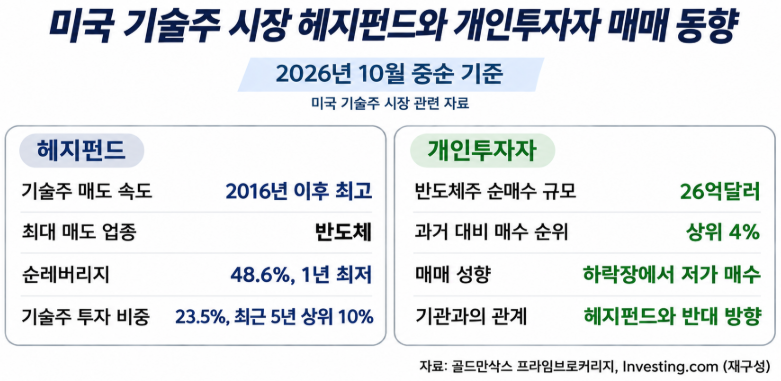
However, the proportion of technology stocks held was 23.5%, remaining in the top 10% for the past five years. This means that even after the massive sell-off, there is a significant amount of investment concentrated in technology stocks.
The trading directions of institutions and individuals also diverged. In the same week that hedge funds intensively sold off semiconductor stocks, individual investors net bought about $2.6 billion. Compared to past purchase sizes, it ranks in the top 4%.
In an article for Investing.com on the 27th of last month, market analyst Michael Lebowitz assessed that the record selling speed does not mean a sell-off. The proportion of investment in high-tech stocks has decreased somewhat, but there remains room to further reduce holdings.
Conversely, when the market stabilizes, hedge funds that have reduced their borrowing ratio may increase their purchases of technology stocks again. However, individual investors who started buying at low prices in mid-October also turned to selling during the sharp decline on November 5. According to Bandari Research, at the time, the volume of individual stock sales by individuals was heading toward the highest level since the COVID-19 incident.
#### Simultaneous selling scarier than AI bad news... ETFs also estimated to be for sale at $47 billion
In a situation where investment funds are concentrated in AI-related stocks, a decline in some large stocks may lead to widespread selling. Funds that use borrowings or set loss limits may need to reduce their holdings as stock prices fall. It is a vicious cycle where selling causes prices to fall, and further declines stimulate selling again.
In the U.S. stock market on the 5th, the asset adjustment of leveraged exchange traded funds (ETFs) was also mentioned as a selling pressure. Nomura estimated that leveraged ETFs would have to sell about $47 billion worth of stocks by market close. This is an estimate, not the actual sale amount.
Leveraged ETFs adjust their holdings to track the daily returns of the underlying index at a certain multiple. If these transactions are concentrated in a sharp decline, the decline in large technology and semiconductor stocks may increase.
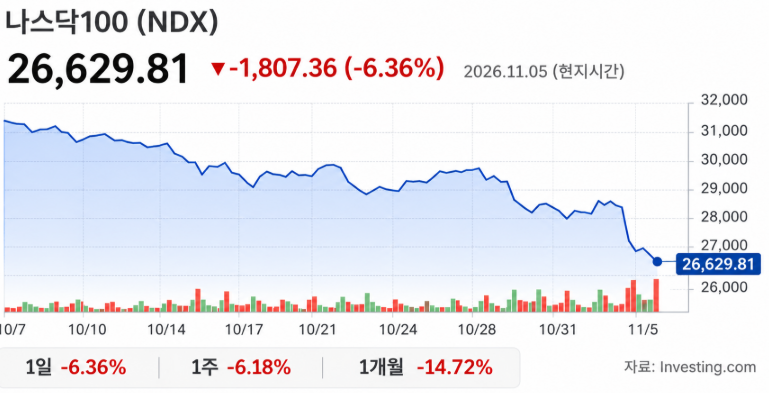
On the 5th, the Nasdaq 100 index plunged 6.36%, closing at 26,629.81. About $2.5 trillion in market capitalization disappeared, and the volatility index (VIX) soared to 28.36 during the day and closed at 28.18.
AI investment profitability and uncertainty in the data center business were cited as reasons for the decline in stock prices, but the market is also paying attention to the possibility that accumulated investment concentration and risk reduction transactions may have increased the decline.
#### Funds flocking to U.S. government bonds... Bio stocks rise despite KOSPI plunge
The sell-off spread centered on AI technology stocks, but not all industries were hit the same way. As investors began to consider performance stability and economic defense rather than growth expectations, the temperature difference within the market also widened. Unlike expectations for expanded AI investment, which drove up stock prices, the huge investment costs and uncertainty about the timing of profit recovery emerged as a burden during the sharp decline.
In the US bond market, there was a buying trend of government bonds due to preference for safe assets. In the stock market, the healthcare industry, which is relatively less sensitive to economic fluctuations, was mentioned as an alternative. Investors' interest, which had been focused on technology stocks, appears to be expanding to other assets and industries.
While KOSPI plummeted on the afternoon of the 6th, pharmaceutical and bio stocks such as SK Bioscience, Hanmi Pharmaceutical, and Samsung BioLogics maintained their upward trend. Expectations of easing the financing burden due to falling interest rates are also considered a positive factor for the bio industry.
Hedge funds' selling of technology stocks has already begun, but investment concentration remains high. As leverage has been reduced, there is still room to repurchase once the market stabilizes. The problem is that additional selling may occur before confidence in AI investment is restored. The 'narrow exit' that Wall Street is concerned about is also here.