Chairman Song Byeong-jun "Actors' guarantees are soaring"… As programming and casting practices encourage production costs to rise, the industry requests a total support system of 1 trillion won over 5 years... "We need to end the practice of focusing production costs on one person."
The K-drama industry has requested the government to establish an investment and support system worth a total of 1 trillion won over 5 years to revive the production base. This is because both works and jobs are decreasing due to rising production costs and a decline in investment and programming. At this press conference, it was also pointed out that the structure focuses costs on a few star actors. There are voices calling for improved star-centered casting and programming practices along with expanded support.
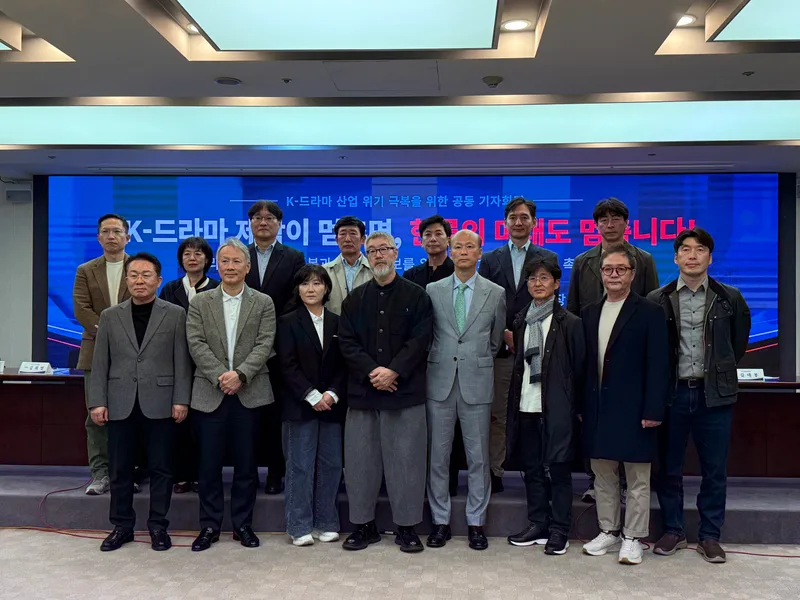
Twelve drama-related organizations, including the Korean Drama Producers Association, the Korean Drama PD Association, and the Korea Broadcast Writers Association, held a joint press conference at the Korea Press Center in Jung-gu, Seoul on the 4th and urged the government and National Assembly to restore the production base. According to the association's tally, the number of domestic drama productions decreased by about 30% in two years from 141 in 2022.
Song Byeong-jun, president of the Korean Drama Producers Association, said, "When the number of works decreases, jobs disappear, and once a production site is destroyed, it is very difficult to restore it." He added, "Now is not the time to look back on past glory, but to look ahead to the next 10 years."

[Photo caption=Remarks by Chairman Song Byeong-jun./Provided by=Korea Drama Producers Association]
"Casting of a specific actor is a condition for programming"… Vicious cycle of rising guarantees
The key issue surrounding the rise in production costs is the appearance fees of star actors and the investment and programming practices that support them. In a structure where a specific actor must appear to sell a work and secure programming, production companies are forced to compete for casting despite accepting high guarantees.
Chairman Song pointed out, "Casting a specific first-class actor became a priority condition for programming, leading to a surge in actor guarantees and an increase in overall production costs," and added, "As a result, the vicious cycle of decreasing the number of films produced has become entrenched."
Overseas buyers' preference for stars was suggested as a factor reinforcing this structure. Chairman Song explained, "In order to purchase, we require top actors on a specific list. Ultimately, broadcasters also consider who appears and has been cast as the priority condition for programming rather than the content or production quality of the drama."
Star appearances can contribute to attracting investment and overseas sales. However, as the cost required for casting increases, the sales standard that must be secured to recover the investment increases. If the amount that buyers and broadcasters can afford does not increase together, a situation will arise where it will be difficult to lead to production and programming even if a star is secured. This is why the industry takes issue with purchasing and programming practices along with appearance fees.
"We need to eliminate production costs that are concentrated on one person"... Self-rescue measures included in the request for support
The request for support presented by the industry on this day is distinct from the request to maintain the existing high-cost production method. Chairman Song presented dramas worth about 10 billion won per work as eligible for support, emphasizing a production structure that provides opportunities to newcomers.
He said, "We are asking for budget support for dramas with a healthy structure that provide opportunities to hire new talent and eliminate the practice of focusing production costs on one person, so that many new people can have opportunities."
In a limited budget, if costs are concentrated on a few lead actors, the ability to allocate them to other participants and production elements may be limited. In order to maintain other costs, the total production cost must be increased, and if the total amount is limited, there is a possibility that the hiring of supporting actors and new actors, compensation for staff, and investment in the completeness of the work will be pressured. It is pointed out that an increase in production costs does not mean an improvement in the treatment of the entire field.
Of course, it is a matter of confirming through separate data whether the increase in the lead actor's guarantee led to an actual decrease in the supporting actor's salary. What was specifically raised at this press conference was the reduction in opportunities for appearing, writing, and filming due to the decrease in production volume, and the departure of skilled personnel.
Park Hae-young "All the assistant writers are not working"

[Photo caption=Remarks by writer Park Hae-young./Provided by=Korea Drama Producers Association]
Park Hae-young, author of 'My Mister' and 'My Liberation Journal' and chairman of the copyright committee of the Korea Broadcasting Writers Association, pointed out the lack of jobs for new creators.
Writer Park said, "Once I finish a drama, I have to hand over the next program to an assistant writer, but all the assistant writers under me are not working," adding, "Writers are starting to move on to short-form, web-based content, and games."
A decline in production not only reduces current jobs, but can also narrow the path to nurturing the next generation of creators. If personnel who need to gain experience by participating in a work move to another field, it will take time to revive existing capabilities even if production volume recovers in the future.
Kim Tae-bong, president of the Korea Broadcasting Photographers Association, also said, "I don't think the decline in the number of productions is a simple quantitative decline," and pointed out, "The problem is that staff members who have accumulated experience and skills are unable to demonstrate their accumulated capabilities and have to leave the field."
1 trillion won is planned for 5 years of support... Production and distribution connection is key
Twelve organizations requested the establishment of national policy goals to restore the number of annual drama productions, the establishment of a mid- to long-term investment and support system, and the establishment of a comprehensive government-wide response system. The 1 trillion won is a plan to provide 200 billion won per year in installments over 5 years, and is not a confirmed government policy.
The industry proposed a plan in which the government would support half of the approximately 400 billion won in costs needed to produce about 40 dramas worth approximately 10 billion won per episode per year, and the broadcasters and platforms would share the remainder. The purpose is to connect production support with the programming and distribution of domestic broadcasters and OTT.
Chairman Song explained, "It is a priming resource that is invested over five years rather than in one year."

[Visual description = Press conference group leader (Vice President Kim Hee-yeol, writer Park Hae-young, Chairman Song Byeong-jun, Chairman Kim Jong-chang, Chairman Song Young-woong, Chairman Kim Tae-bong). / Provided by = Korean Drama Producers Association]
Kim Hee-yeol, vice president of the Korean Drama Production Association, also explained the support plan based on dramas with a production cost of about 800 million won per episode, saying, "If we support seven broadcasting companies, including cable channels, to produce about five dramas per year, we will be competitive in recovering the number of productions." He emphasized the need for a sustainable production environment, saying that this does not mean that 141 episodes, the number of episodes produced in 2022, should be reproduced unconditionally.
After a box office hit, profits must also come from the next work.
In addition to rationalizing costs at the production stage, a structure to secure profits after box office success was also presented as a task. This means that only if a production company can accumulate the results of successful works will it have the ability to reinvest in the next work.
Chairman Song said, "If there is anything I want from global OTT, it is a structure that does not completely take over IP and a distribution of profits commensurate with success."
At the same time, the contribution of global OTT was also recognized. He said, "It is true that global OTT has helped lead the Korean Wave and further raised the quality of dramas," but argued that the number of films produced has decreased as existing broadcasters have been unable to keep up with the increase in production costs. This reflects the industry's awareness of the need to maintain the advantages of platform investment inflow but also secure conditions for reinvestment based on domestic production.
What needs to be confirmed in this support discussion is not just the size of the investment. We need to examine whether the subsidies increase new works and jobs, improve the cost structure concentrated in a few areas, and whether completed works lead to programming and distribution. The industry also announced that it would prepare self-rescue measures such as rationalizing the production cost structure and establishing fair production practices.
Chairman Song said, "What is more important than the global success of one out of 100 films is the remaining 99 that attract talent and guarantee jobs." Whether it is possible to maintain the box-office competitiveness of stars and the activity base of many creators has emerged as a key issue in discussions about K-drama support.