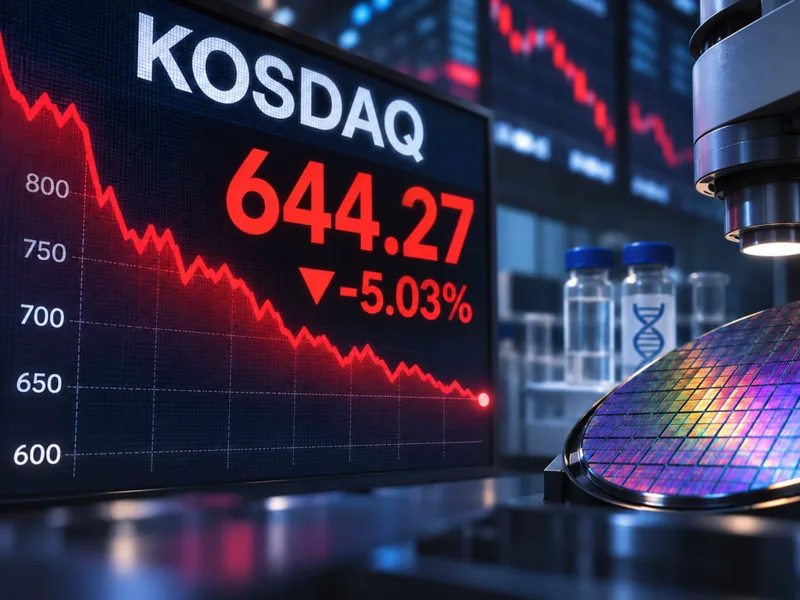
Market capitalization shrinks to 366 trillion won, falling below late-2024 levels to threaten the 600 threshold
Concerns mount over retail-heavy trading structure and short-selling shocks as government's 'Select' segment effectiveness comes under scrutiny
The KOSDAQ has finally slipped into the 600-point level, barely a week after concerns were raised over a potential collapse below 700 at the end of last month. As a "Blue Wave" sweep by the Democratic Party in the U.S. midterm elections materialized, fears spread regarding tighter regulations on artificial intelligence (AI) data centers and reduced capital spending. With the shock of steep drops in U.S. tech stocks spilling over into global equity markets, the KOSDAQ—which had previously rallied on the back of semiconductor materials, components, and equipment makers—quickly surrendered its gains.
On November 6, the KOSDAQ closed at 644.27, down 5.03% from the previous trading session. Intraday, it dipped as low as 629.17, with over 1,400 stocks declining. Compared to its intraday closing peak of the year recorded on April 27 (1,226.18), the index tumbled 47.5% in just six months.
During the same period, KOSDAQ's total market capitalization shrank by approximately 313 trillion won, falling from around 679.5 trillion won to 366.5 trillion won. The index broke below its late-2024 baseline of 678.19, wiping out two years of gains. Market participants are now bracing for the risk of the index breaking below the 600 mark entirely.
Was Capital Concentration in Semiconductor Equipment a Harbinger of the Crash?
Prior to the sharp market drop, a heavy concentration of funds into a single sector was already strikingly evident. At the start of the year, not a single semiconductor firm was listed among the KOSDAQ's top 10 companies by market capitalization, but by early October, that count surged to six. Conversely, pharmaceutical and biotech firms dropped from seven to just one over the same period. In the top 30 rank, semiconductor-related companies jumped from four to 17, illustrating how severely capital became tilted.
A prime example is Jusung Engineering, which even earned the nickname "Jusung Electronics." It surged from the 57th largest stock by market cap at the beginning of the year to become the second-largest during trading on October 1. At that time, its market capitalization reached 11.23 trillion won, despite recording an operating profit of just 31.3 billion won last year and cumulative operating profit of 12.1 billion won through the third quarter of this year. Critics argue that expectations for future contract wins and earnings growth were excessively priced into its valuation relative to its actual earnings scale.
Investments in AI and high-bandwidth memory (HBM) certainly present growth opportunities for semiconductor equipment makers. However, over-concentrated expectations on future performance within a single industry left the market highly vulnerable when global investment sentiment shifted.
Between November 4 and 6, following the U.S. midterm election results, the KOSDAQ index dropped 8.5%. Major semiconductor equipment stocks suffered far steeper losses: Jusung Engineering (-14.4%), EO Technics (-20.8%), LEENO Industrial (-12.9%), and Simmtech (-16.7%). The synchronized drop among top-tier semiconductor equipment names magnified downward pressure across the index, laying bare the structural fragility of a market heavily weighted toward a single sector.
Meanwhile, prospects of a resurgence among pharmaceutical and biotech firms, which lost ground to semiconductor stocks in the top market cap ranks, are gaining attention. Upcoming clinical trial results and technology licensing agreements are expected to be key variables for reclaiming leadership, with market focus turning to firms such as AriBio Holdings and HLB Therapeutics, both set to announce global Phase 3 results this month.
A Retail-Driven Market: Are Short-Selling Safeguards Sufficient?
At the core of KOSDAQ's vulnerability to external shocks lies a trading structure heavily dominated by retail investors. An analysis of Korea Exchange (KRX) data shows that through November 6 this year, retail investors accounted for 65.33% of total KOSDAQ trading volume, far exceeding the KOSPI's 37.75%. In contrast, institutional investors accounted for only 8.98% on the KOSDAQ, just a third of their 24.73% stake on the KOSPI.
With low institutional participation, a sharp decline in investor sentiment during market downturns severely weakens buying power. Forced liquidations from margin calls can trigger secondary sell-offs, compounding losses. When concentrated short selling and linked spot-futures trading are factored in, market volatility risks escalating further.
The problem is that short selling is allowed across all listed stocks on both KOSPI and KOSDAQ, despite their vastly different market structures. While short selling serves positive functions such as price discovery and liquidity provision, intense selling pressure can impose a heavy burden on KOSDAQ companies whose market values rely heavily on future growth expectations rather than immediate earnings performance.
Although KOSDAQ operates specific criteria for designating short-sale overheated stocks and extending short-sale prohibition periods, questions remain over whether these act as sufficient safety nets during market crashes. While short selling cannot be singled out as the direct cause of the recent slump, it underscores the urgent need for a differentiated risk management framework tailored to market characteristics.
Amid steep downturns, regulators should consider enhancing the flexible operation of existing criteria for short-sale designation and restriction periods, while strengthening oversight of linked spot-futures trading and implementing effective institutional improvements to cushion the impact of margin liquidations.
Will Segmenting Companies Make a Difference? Long-Term Investment Base Is Key
The effectiveness of market revitalization measures pursued by the South Korean government and the KRX also warrants scrutiny.
Targeting 2027 for implementation, the KRX is pushing for a tier-based segment system that categorizes listed companies into prime firms ('KOSDAQ Select'), general firms, and administrative watchlists. On November 6, the exchange unveiled a concept to cap the combined market cap of 'Select' companies at approximately one-third of the total KOSDAQ market.
Authorities are also discussing mandatory annual investor relations (IR) sessions for all KOSDAQ-listed firms, dedicated active exchange-traded funds (ETFs) for general firms, as well as policy financing and tax incentives with relevant government agencies.
The intent to enhance corporate disclosure transparency and foster blue-chip companies is sound. However, the 'KOSDAQ Global Segment'—which selected 51 prime companies—was already launched in November 2022. While the exchange plans to address past limitations through promotion-demotion systems and expanded financial products, it remains uncertain whether simply reclassifying companies will drive inflows of long-term institutional capital.
Crucially, if institutional capital concentrates solely on 'Select' firms, other emerging growth companies could face further marginalization. Regulators must evaluate the performance of the existing Global Segment while verifying whether the new system can genuinely expand the broader investment foundation for KOSDAQ as a whole.
KOSDAQ was originally established to support fund-raising for small and medium-sized enterprises (SMEs) and ventures possessing technological prowess and growth potential, not just companies generating high profits immediately. It is essential to distinguish temporary losses from research and development expenses from structural distress, while simultaneously strengthening safeguards for long-term investments in growth enterprises.
The potential for a KOSDAQ rebound remains open. Improving conditions in the semiconductor cycle or clinical and licensing breakthroughs from biotech firms could serve as new upward catalysts. However, merely shifting market leadership from semiconductors to biotech will not resolve the market's underlying structural flaws.