SpaceX deals about $20 billion, Amazon $11.57 billion... Accelerating entry into the mobile communication market Expanding the market from wars and disasters to communication vulnerable areas... Korea is also considering its own network of up to 512 units
Low-orbit satellites are filling the gaps in terrestrial communication networks, not only in oceans and mountainous areas, but also in rural areas of Africa where communication infrastructure is lacking. The market for satellite communications is also rapidly expanding as the technology that not only provides Internet access hundreds of kilometers above the sky but also directly connects regular smartphones has been commercialized. While Space
The focus of competition is shifting from satellite launches to securing frequencies and mobile communication subscribers. The total amount of related transactions concluded between SpaceX and Amazon amounts to approximately $31.6 billion, or KRW 45 trillion. As it is difficult to enter the general mobile communication market simply by building a satellite network, efforts to secure frequency use rights and existing communication networks are in full swing.
#### SpaceX, which has over 10,000 satellites, is also eyeing mobile carriers
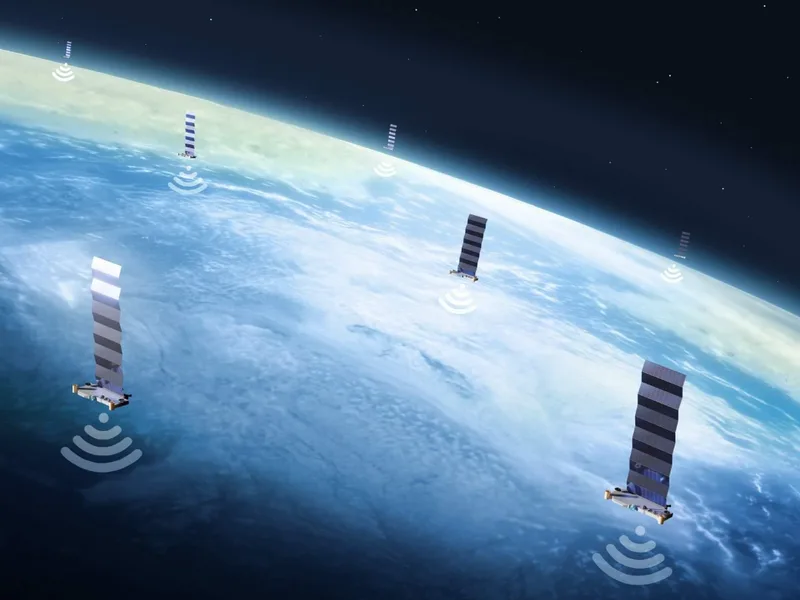
SpaceX operates more than 10,000 Starlink satellites and is at the forefront of the low-orbit satellite Internet market. In order to expand the advantage gained in satellite network construction to general smartphone services, it signed a frequency transaction agreement of up to 65 MHz with Ecostar, a U.S. satellite and mobile communication service provider, last year. The transaction size, including additional contracts, was approximately $20 billion, and cash and SpaceX stock were included in the payment consideration. The frequency transfer process is still in progress.
Following securing frequencies, the company is also expanding into the terrestrial mobile communication business. At the time of signing the contract with Ecostar, Space Boost Mobile provides services by leasing the networks of AT&T and T-Mobile. If cooperation expands, SpaceX will be able to provide services to general mobile communication subscribers by linking satellite networks and ground base stations. However, the negotiations have not been confirmed.
Amazon is narrowing the gap through mergers and acquisitions. The U.S. Federal Communications Commission (FCC) approved Amazon's acquisition of Global Star on the 27th of last month. The transaction size is $11.57 billion. Global Star is a company that supports the satellite emergency rescue function of the Apple iPhone, and once the acquisition is completed, Amazon will secure frequencies and satellite and terrestrial communication facilities. Unlike Space
Amazon is also building its own satellite network, 'Amazon Leo'. Satellite launches began in April last year, and approximately 3,200 satellites are planned to be deployed. Separately, the company also applied for permission to operate up to 5,105 satellites for direct communication with smartphones. While Space
What the two companies are targeting is the D2D (Direct-to-Device) market, which connects regular smartphones directly to satellites. While existing satellite Internet required a separate receiving terminal, D2D is a method of communicating with a satellite using a smartphone even in places where ground base stations cannot reach. As the scope of services expands from text and emergency communications to voice and data, the business areas of satellite communications operators and existing mobile carriers become closer. This is why the competition that started in space continues to secure mobile communication subscribers on the ground.
The scope of satellite communication has already surpassed commercial services. In Ukraine following the Russian invasion, Starlink supported military and civilian communications. At the same time, the issue was raised that dependence on overseas private operators could lead to security risks. A new telecommunications market can be opened in rural areas of Africa where it is difficult to build optical cables and base stations, but securing actual subscribers must be supported by rates and the distribution of terminals.
As the impact of satellite communications on national security and the mobile communications market grows, frequency policies are also changing. On the 29th of last month, the FCC proposed a 25 MHz frequency auction and began considering expanding the frequency sharing bands for satellite and terrestrial networks from 5 to 13. The possibility of additional use of up to 482 MHz is discussed, but actual opening has not been confirmed.
#### Korea is also considering up to 512 units... 14 trillion won independent network, who will pay?
The Korean government is also reviewing the scale of the project with the goal of building its own low-orbit satellite communication network (K-LEO) in 2035. Three scenarios were presented, ranging from 128 satellites and approximately 4 trillion won to 256 satellites and approximately 7.4 trillion won, and 512 satellites and approximately 14.3 trillion won. This is a cost estimate for each cycle assuming a satellite lifespan of 5 years, and the actual project scale and budget have not been confirmed. The nature of the deal is different from that of U.S. companies securing frequencies.
The government's plan is to secure satellite mass production and launch technology in 2030, verify space operation in 2032, and build an independent network in 2035. In order to put hundreds of satellites into orbit, securing launch capabilities must come first. Oh Tae-seok, head of the Korea Aerospace Administration, also explained in a government audit last month that domestic launch vehicles alone have limitations, so it is necessary to use overseas launch vehicles.
Even if a company has launch capabilities, it is difficult to sustain business without stable demand for services. At the K-Space Forum on the 28th of last month, Kim Seon, Hanwha Group's vice president of space business, said, "The government should be the agent of market formation, that is, the purchaser of services, rather than the agent of development." The explanation is that long-term purchase contracts in the defense and public sectors can support private investment and satellite network operation.
Apart from building their own networks, domestic companies are also expanding their business base in the overseas satellite communication market. Hanwha Systems has been developing military communication systems and mobile terminal technology using Eutelsat OneWeb's satellite network. IntellianTech supplies antennas and terminals to overseas satellite operators, and in February of this year, it unveiled Eutelsat and a portable low-orbit communication terminal for military and government agencies.
While Space Securing customers and operating profits who will continue to use them has become as important as securing hundreds of satellites.